Why it’s hard to scale a tutoring business
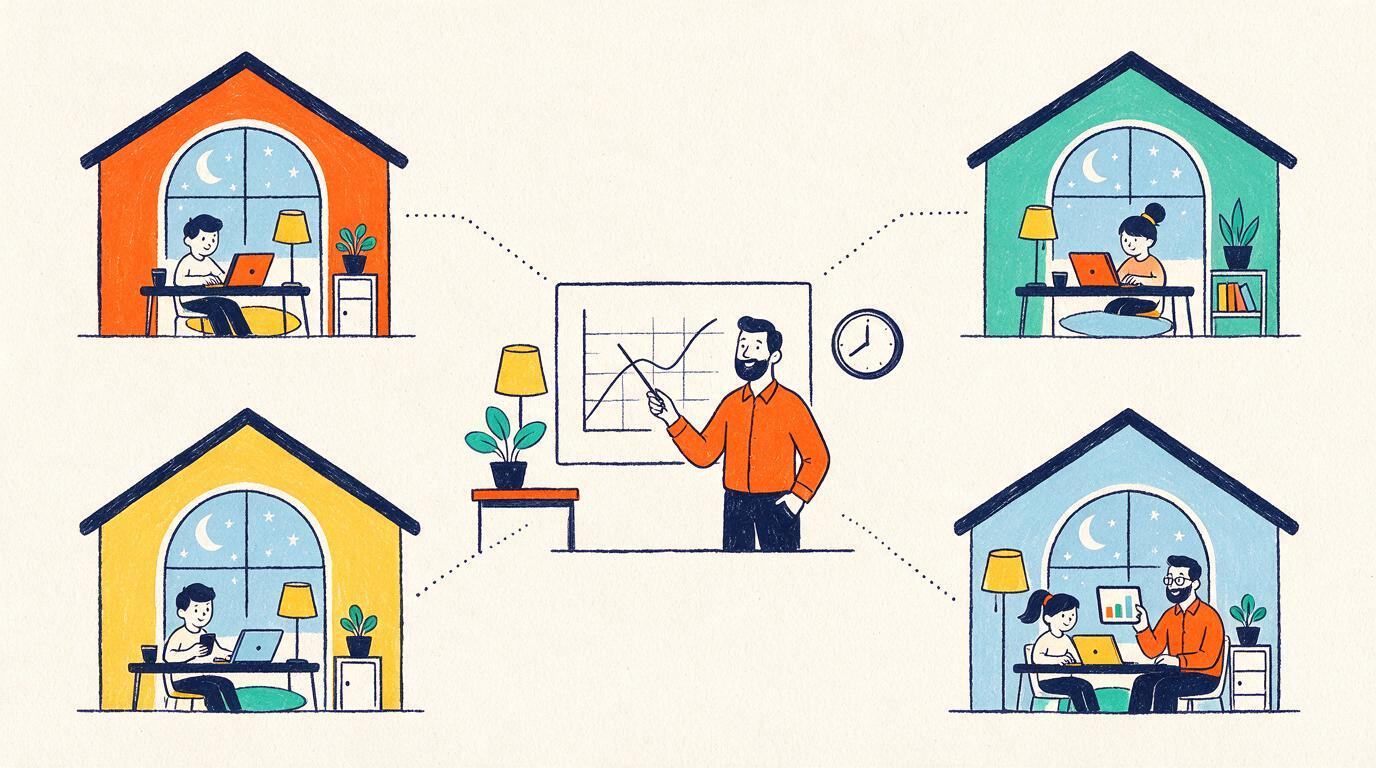
A tutoring business has one production constraint: tutor hours. Revenue is hours sold × rate, and the hours are not evenly available. K-12 students can meet after school and before bedtime on weekdays, plus some weekend time. If your students can only book between 3:30 and 8:30 pm on school days, a tutor has 25 prime-time hours a week before travel, breaks and cancellations. At an assumed $80 an hour, that caps prime-time revenue at $2,000 a week per tutor, however good they are.
The usual ways to scale a tutoring business each trade something away:
- Raise rates. Works until your market says no, and it narrows who you can serve.
- Move to groups. More revenue per hour, less attention per student. Group size is one of the design features in the research below.
- Hire more tutors. Margin per hour stays the same, and quality control gets harder with every evening-only hire.
- Sell recorded courses. Scales well, but loses the thing families pay for: someone noticing the student is lost.
AI for tutoring companies adds a fifth option: keep the live hour, and add structured practice between sessions that does not need a tutor in the room. Whether that grows the business depends on how you split the work and price it, which the rest of this guide covers.
Why frequency matters more than one long session
The strongest evidence on tutoring points to frequency and structure. The National Student Support Accelerator at Stanford defines high-impact tutoring as sessions three or more times a week for ten or more weeks, one to one or in groups of no more than four, with consistent, well-trained tutors, data-driven instruction and materials that complement classroom teaching.
A meta-analysis of randomized tutoring experiments by Nickow, Oreopoulos and Quan, published in the American Educational Research Journal in 2024, found an overall pooled effect of 0.288 standard deviations. Effects tended to be largest for programs that used teachers or paraprofessionals as tutors, served earlier grades, met at least three days a week and ran during school.
A large example is the Chicago study by Guryan and colleagues in the American Economic Review (2023). Ninth and tenth graders were tutored for a class period every day, two students per tutor. Math tutoring raised math test scores by 0.18 to 0.40 standard deviations and improved course grades, with effects persisting into later years. The authors write that their data are consistent with more personalized instruction as the mechanism.
Be honest about what this does and does not show. These are studies of human tutors. They do not prove an AI tutor produces the same gains; for the wider evidence on AI, see our post on Bloom’s 2 sigma problem. What they support is the design: frequent, structured practice tied to the curriculum, with someone watching the data. Many families cannot pay for a human tutor three or more times a week. A hybrid model tries to supply the frequency with practice while the human keeps the judgment.
There is also early evidence that AI can raise the quality of human tutoring. In a randomized trial with 900 tutors and 1,800 K-12 students, Wang, Ribeiro, Robinson, Loeb and Demszky (2024) gave tutors an AI assistant that suggested teaching moves during sessions. Students of tutors who had it were 4 percentage points more likely to master topics, and 9 points more for students of lower-rated tutors. That tool advised the tutor rather than teaching the student, but it points the same way: AI used around a human tutor, not instead of one.
What an AI tutor can take, and what must stay human
Split the work by job, not by student. Every student keeps a human tutor. The AI takes the repetitive one-to-one work around the live session.
| Job | AI tutor between sessions | Human tutor |
|---|---|---|
| Homework help and practice | Explains, asks, hints before answers, from your worksheets and notes | Sets the practice and reviews the results |
| Revision before a test | Short recaps with a check after each concept | Decides what to revise and when |
| Pre-session diagnostic | A 10-minute check on last week’s topics; weak concepts listed for the tutor | Reads it and plans the hour |
| Post-session recap | Re-teaches what was covered, with a question on each point | Chooses what goes into the recap |
| Relationship and motivation | No | Yes: the reason many students keep going |
| Test strategy and study plans | Only what your material teaches | Yes |
| Parent conversations | No; supplies the progress data | Yes |
| Spotting a possible learning difficulty | No; it can show a pattern, not diagnose | Notices, talks to parents, suggests a professional evaluation |
The practice sessions work best when every check asks the student to produce something: the next step, a prediction, an explanation in their own words. Our guide to checking for understanding lists twelve formats that work online.
How to package a hybrid tutoring model and what it does to margins
Package the hybrid model as live hours plus a capped allowance of AI practice minutes. The cap keeps your cost predictable and tells families what to expect. The example below uses stated assumptions; replace them with your own rates.
Assumptions: you charge $80 per live hour and pay tutors $35 an hour. A month is four weeks. The AI practice cap is three 20-minute sessions a week (240 minutes a month) at $0.03 a minute, costed as if every minute is used. The tutor spends 30 minutes a month per hybrid student reading reports and transcripts, paid at the same rate. Each tutor has 80 hours a month.
| Weekly live only | Hybrid, weekly live | Hybrid, live every other week | |
|---|---|---|---|
| Family gets per month | 4 live hours | 4 live hours + up to 240 AI minutes | 2 live hours + up to 240 AI minutes |
| Sessions per week | 1 | 4 | 3.5 on average |
| Price per month | $320 | $360 | $220 |
| Tutor time per student | 4 h ($140) | 4.5 h ($157.50) | 2.5 h ($87.50) |
| AI cost at the cap | $0 | $7.20 | $7.20 |
| Gross margin per student | $180 (56%) | $195.30 (54%) | $125.30 (57%) |
| Students per tutor (80 h) | 20 | 17 | 32 |
| Gross margin per tutor per month | $3,600 | $3,320 | $4,010 |
Three things fall out of the arithmetic:
- The AI minutes are not the cost that matters. $7.20 a month is small next to the tutor’s review time. Budget the review, and price it.
- Hybrid weekly is an upsell, not a scaling model. It gives the student four touchpoints a week for $40 more, but each tutor serves fewer students because of review time. Price it higher if the review is real.
- Hybrid every other week is the scaling model. A lower price point opens the business to families who cannot pay $320 a month, the student still practices three or more times a week, and each tutor serves 32 students instead of 20. Do not move a struggling student onto it just to fill a slot; the live hour is still where the hardest teaching happens.
For other pricing models (per seat, per student, per minute), see how much an AI tutor costs, and for the honest comparison of AI and human tutoring, see Tutezy vs human tutoring.
How to explain it to parents
Tell families before it starts, in plain words, and give them a way out. Expect two worries: that they are paying for a human and getting a machine, and that their child’s data goes somewhere unknown. Answer both. A short script you can adapt:
Two cautions. Do not call the AI “a tutor just like me”; it is not, and families will notice. And if you teach children under 13 in the US, COPPA places requirements on online services directed to them, so ask your vendor how they handle children’s data and check your obligations with counsel. This is not legal advice.
Quality control: reviews, reports and escalation rules
A hybrid model fails quietly when nobody reads the output. Build three habits into the tutor’s week and one set of written rules.
- Review compiled lessons before release. Work through each lesson as a student would, including one deliberately wrong answer per concept. If a board or hint is off, fix the source material and recompile.
- Read the weekly report. Concept mastery per student, the concepts the whole group missed, and minutes used. The group misses go into the next live session.
- Read transcripts. All of them for the first two weeks, then five per tutor per week.
Then write escalation rules down, so they do not depend on memory:
- The same concept flagged weak in two practice sessions: the tutor reteaches it live at the next session.
- No practice minutes in seven days: the tutor messages the student, then the parent.
- A parent complaint about the AI: a call from the tutor within one business day.
- Anything worrying in a transcript, or a pattern that looks like more than a content gap: a human conversation the same week. An AI tutor is not a safeguarding or diagnostic tool; do not rely on it to notice a child in distress.
An eight-week rollout plan
Start small, with your best material and your most engaged families, and decide on packaging only once you have your own numbers.
- 1
Week 1: pick one subject
Choose the subject and grade where your material is strongest, such as Algebra 1 worksheets plus a few recorded sessions. Write down what success would look like. - 2
Weeks 1–2: compile and review
Turn the material into lessons, then work through every lesson as a student. Fix the source, not the symptom. - 3
Week 2: invite 10–20 students
Pick current students whose families are engaged. Use the parent script, and start only with their agreement. - 4
Weeks 3–7: run the hybrid week
Three 20-minute practice sessions a week between live sessions. The tutor reads the report before every live hour and follows the escalation rules. - 5
Week 8: measure
Practice sessions completed per week, check scores on concepts retaught, live time spent on new material versus re-explaining, tutor hours per student, parent feedback. - 6
Then: price and expand
Set package prices from your measured costs, add a second subject, and hire tutors for live hours only when the live calendar is full.
Where Tutezy fits
What we built for this
Tutezy is the practice layer in this model. It compiles your notes, worksheets and recorded sessions into one-to-one whiteboard lessons that explain, ask a question after each concept, give hints before answers and revisit weak concepts. Lessons can speak in your cloned voice ($20 one-time, with your recorded consent) or a stock voice, including American English. You get concept mastery per student, weak spots per batch, minutes used and session transcripts that only your admins can see. It costs $0.03 per learner-minute, with no seat licenses; see pricing.
What it is not: a replacement for your live session, a safeguarding tool, or a fit for very young children who cannot yet read a board and answer a question. It teaches only the material you give it, in English or Hindi. Students use it inside your branded Vacademy learner app on web, Android and iOS, so if you are not on Vacademy, onboarding comes first. The independent tutors page has a worked example.
Sources
- National Student Support Accelerator, Stanford University. What is high-impact tutoring? nssa.stanford.edu/about/high-impact-tutoring
- Nickow, A., Oreopoulos, P., & Quan, V. (2024). The promise of tutoring for PreK–12 learning: A systematic review and meta-analysis of the experimental evidence. American Educational Research Journal, 61(1), 74–107. doi.org/10.3102/00028312231208687
- Guryan, J., Ludwig, J., Bhatt, M. P., Cook, P. J., Davis, J. M. V., Dodge, K., Farkas, G., Fryer, R. G., Jr., Mayer, S., Pollack, H., Steinberg, L., & Stoddard, G. (2023). Not too late: Improving academic outcomes among adolescents. American Economic Review, 113(3), 738–765. doi.org/10.1257/aer.20210434
- Guryan, J., et al. (2021). Not too late: Improving academic outcomes among adolescents (NBER Working Paper No. 28531; program design details). www.nber.org/papers/w28531
- Wang, R. E., Ribeiro, A. T., Robinson, C. D., Loeb, S., & Demszky, D. (2024). Tutor CoPilot: A human-AI approach for scaling real-time expertise. arXiv:2410.03017. arxiv.org/abs/2410.03017
- U.S. Federal Trade Commission. Children’s Online Privacy Protection Rule (COPPA). www.ftc.gov/legal-library/browse/rules/childrens-online-privacy-protection-rule-coppa
Frequently asked questions
How do I scale a tutoring business without hiring more tutors?+
Separate the work that needs a person from the work that needs practice. Keep live sessions for teaching, strategy and the relationship, and move homework help, practice and revision between sessions to an AI tutor taught from your own material. That lets each tutor serve more students, or give each student more practice days, without adding evening hours.
Will AI replace tutors?+
Not for the parts families pay a tutor for: the relationship, motivation, judgment about what a student needs next, and conversations with parents. An AI tutor can take repetitive explaining and practice, which frees the tutor’s hours for that work. The research on large tutoring gains is about human tutors, so a hybrid model keeps them at the center.
What is a hybrid tutoring model?+
A hybrid tutoring model combines live sessions with a human tutor and structured practice between sessions, which an AI tutor can deliver. The tutor reads a report of what the student got right and wrong before each live session and starts there. Packages usually pair a set number of live hours with a capped allowance of AI practice minutes.
How much should I charge for AI tutoring as part of a package?+
Price the outcome and the tutor’s time, not the AI minutes. At $0.03 per minute, three 20-minute practice sessions a week cost about $7.20 a month per student at the cap, so the AI cost is small next to tutor time. Most of the extra cost is the tutor’s time reading reports, which should be built into the price.
Should I tell parents my tutoring uses AI?+
Yes, before it starts. Tell them what the AI does, what the tutor still does, what is recorded and who can see it, and that you will stop using it for their child if it is not helping. It is far better for them to hear it from you than to discover it later in a transcript or an invoice.
Is an AI tutor safe for young children?+
It depends on the product and the child. A tutor that teaches from reviewed material and logs every session is easier to supervise than an open chatbot, but very young children who cannot yet read a board and answer a question are not a good fit. For children under 13 in the US, check your privacy obligations under COPPA with counsel.
See it teach
Take a 10-minute lesson, then book a demo on your own content.
No sign-up for the lesson. The call is 20 minutes and we convert one of your chapters live. We're in India. Calls run 9:30 am–3:30 pm ET (7 pm–1 am IST), Monday to Friday.