Why use a teacher’s own voice, and when a stock voice is fine
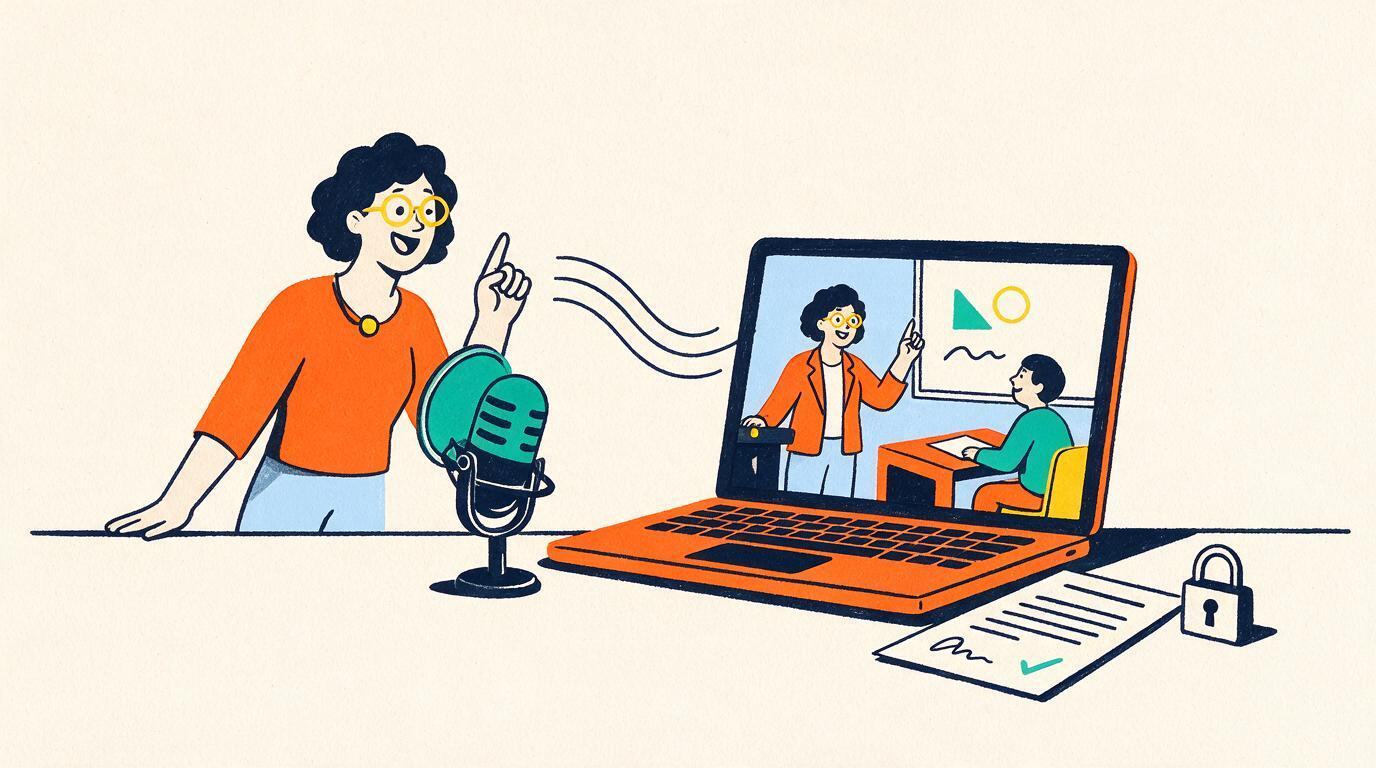
Teachers and course creators ask about an AI voice clone for one of two reasons. Students already know the teacher from live classes or recorded videos, and a strange voice in the AI lessons breaks that thread. Or the course is sold on one person’s name, and their voice is part of the product. In both cases, the clone buys familiarity and consistency: the lesson sounds like the person the student signed up to learn from, every time.
Do not expect a clone to teach better on its own. In a 2017 randomized study in Computers & Education, Craig and Schroeder compared a virtual human speaking with an older text-to-speech engine, a modern one, and a recorded human voice. The modern engine was rated at the same level as the human voice for facilitating learning and for credibility, and the authors concluded that their results “call into question” the older claim that human voices teach better. The voice needs to be clear and natural. It does not need to be yours.
So a stock voice is often the right choice:
- Corporate, compliance or product training, where no single teacher is the face of the course.
- Programs with many instructors, where one cloned voice would misrepresent who wrote the material.
- A teacher who would rather not be cloned. That answer should end the discussion, with no penalty.
- Pilots, before you know whether students will use the AI lessons at all.
How much audio does an AI voice clone need?
Less than most people expect, but quality matters more than length. Requirements vary by tool and by quality tier, so check the vendor’s own documentation:
- Tutezy clones a teacher’s voice from a 15-second sample, recorded or uploaded by the teacher after they accept a consent statement in the product.
- ElevenLabs recommends about one to two minutes of clean audio for its Instant Voice Cloning, and for Professional Voice Cloning at least 30 minutes, ideally closer to two to three hours. Its documentation says you can only create a Professional Voice Clone of your own voice, and you are asked to verify it.
Short samples capture what your voice sounds like. Longer ones capture more of how you speak: rhythm, emphasis, range. ElevenLabs puts the rule simply, “good consistent input = good consistent output,” and the same holds for any tool. Recording tips that apply everywhere:
- Quiet, soft room. No fans, traffic or echo. ElevenLabs suggests a thick duvet or quilt to dampen a room if you have no treated space.
- Same distance from the mic for the whole take; ElevenLabs suggests about two fists away. Moving closer and farther changes the tone the clone learns.
- Your natural teaching pace and energy. The clone copies the performance you give it, so do not read like a newsreader if you teach like a coach.
- Varied sentences: a statement, a question, a number, an instruction, an encouraging line. Monotone input produces a monotone clone.
- One speaker, no music, no effects. Record a few takes and keep the cleanest, checked on headphones.
How to get voice cloning consent from a teacher
A checkbox in a sign-up flow is not enough when the voice belongs to an employee or contractor. Put the terms in writing, separate from the employment contract, and keep the signed record with the voice. Cover these eight points:
- 1
The right person consents
The person whose voice it is, in writing, from a sample they record or upload themselves. Never from found audio, old lecture recordings or a colleague’s clips. - 2
Scope
Which courses, subjects and languages. Lessons only, unless they agree otherwise. Name the excluded uses: advertising, phone calls, social media, anything they have not reviewed. - 3
Duration
A fixed term, such as one academic year or the life of a named course, with renewal by fresh agreement rather than silence. - 4
Withdrawal and deletion
How to withdraw, how fast the voice is disabled, what is deleted (the voice model and the sample), and written confirmation when it is done. - 5
When they leave
Decide now. A fair default: disabled on the last day and deleted, with lessons switching to a stock voice, unless they sign a separate paid license. - 6
Compensation
State it, even if the answer is that it is part of the role. For creators licensing a voice to a platform or school, agree a fee or share. - 7
Minors
Do not clone students’ voices. If a minor’s voice is ever involved, get a parent or guardian’s written consent first. - 8
A named contact
Who the teacher contacts to review uses, report misuse or withdraw, and how quickly that person must respond.
What to tell students
Tell them plainly, in two places: the course page and the opening of the first lesson. One sentence is enough: “Lessons in this course are taught by an AI tutor that speaks in Ms. Rivera’s voice, with her permission. She reviews the lessons, but she is not speaking live.” Add a line to your FAQ for parents if your learners are young.
Disclosure costs nothing and prevents the worst outcome, a student or parent discovering later that the “teacher” was not the teacher. It also marks a line you should not cross: do not use the cloned voice for phone calls or voicemails to students or parents. In a February 2024 declaratory ruling, the FCC confirmed that AI-generated voices, including voice cloning, count as “artificial” voices under the Telephone Consumer Protection Act, so such calls generally need the called party’s prior express consent.
What US law says about cloning a voice
Voice cloning law in the US is a patchwork that is still being written. As of September 2026, the main markers are:
- Tennessee: the ELVIS Act. The Ensuring Likeness, Voice, and Image Security Act of 2024 was signed on March 21, 2024 and took effect July 1, 2024. It adds a person’s voice to the property rights already protected in their name, photograph and likeness. It creates liability for publishing or making available someone’s voice with knowledge that the use was not authorized, requires a parent’s or guardian’s authorization for minors, and reaches tools whose primary purpose is producing a particular person’s voice without authorization.
- California: AB 2602. Signed September 17, 2024, it added Section 927 to the Labor Code. For new performances fixed on or after January 1, 2025, a contract clause allowing a digital replica of a person’s voice or likeness in place of work they would otherwise have done in person is unenforceable if it lacks “a reasonably specific description of the intended uses” and the person was not represented by a lawyer or a union in the negotiation. For a school or company employing teachers in California, that is a strong reason to write the specific, separate consent described above.
- The FTC. The FTC’s Impersonation Rule, in effect since April 1, 2024, covers impersonating government agencies and businesses, and the FTC has proposed extending it to impersonating individuals. In its 2024 write-up on AI-enabled voice cloning, the agency said plainly that “there is no AI exemption from the laws on the books.”
- Congress. The NO FAKES Act of 2026 (S. 4591), a bill “to protect intellectual property rights in the voice and visual likeness of individuals,” was ordered reported by the Senate Judiciary Committee in June 2026. It is not law.
These are examples, not a complete survey; check the rules in the states where your teachers and students are. This section is general information, not legal advice.
Keeping a cloned voice secure
A voice clone is a credential: anyone who can select it can make the teacher appear to say things. Before you create one with any vendor, get answers to five questions: who else can select the voice, whether it can be exported, whether the sample is used to train anything else, how disabling works, and how deletion is confirmed. The AI tutoring software checklist covers the wider data questions.
As an example of the answers to expect, Tutezy’s security and consent page commits to the following. A voice is cloned only from a sample recorded or uploaded by the teacher or account holder, after they accept a consent statement, and the consent record is kept with the voice. Public figures and colleagues from found audio are refused. The voice is private to the institute: nobody else on the platform can pick it. Disabling it in settings switches lessons to a stock voice immediately, and on request deletion removes both the voice model and the sample. Customer content is not used to train models.
Stock voice, cloned voice or human recording?
| Stock AI voice | Cloned teacher voice | Human recording | |
|---|---|---|---|
| Setup | Pick from a list | A short sample plus written consent | Record every line; re-record for every change |
| Sounds like the teacher | No | Closely, if the sample is clean | Exactly |
| Can say new sentences (feedback, hints, answers to doubts) | Yes | Yes | No, only what was recorded |
| Consent paperwork | None | Scoped, time-limited, revocable | A standard recording release |
| Updating content | Instant | Instant | A new recording session |
| Main risk | Feels generic | Misuse if consent or access control is weak | Goes stale; cannot respond to the learner |
| Best for | Compliance and product training; many instructors | Courses sold on one teacher’s name; continuity with live classes | Short, stable pieces: welcomes, stories, motivation |
You can mix all three: the teacher’s real recording for the welcome video, a cloned voice for the interactive lessons, and a stock voice for courses where no single teacher owns the material. For how interactive lessons fit a course you already sell, see How to add an AI tutor to your online course.
What a teacher voice clone costs
Before you compare prices, check how each vendor charges for cloning (per voice, as part of a subscription, or by usage), how long a voice stays available if you stop paying, and whether deletion is included.
With Tutezy, a teacher voice clone is $20 one-time per voice (₹2,000 in India), usable across every course in the institute, in English and Hindi. Stock voices, including American English, are free. Lesson minutes cost the same $0.03 per learner-minute whichever voice teaches. So an independent course creator pays $20 once; a tutoring company that clones six tutors pays $120 once; and 100 students taking a 30-minute lesson costs $90 in either case. The full rate card is on the pricing page, and the business case for tutoring companies is in How to scale a tutoring business with AI.
Where Tutezy fits
What we built for this
Tutezy uses a cloned voice for one job: teaching an institute’s own material, one to one, on a whiteboard. A teacher records or uploads a 15-second sample after accepting a consent statement in the product; the consent record is kept with the voice; the voice is private to the institute and can be disabled at any time, with lessons falling back to a stock voice, or deleted on request. It costs $20 one-time per voice. An optional lip-synced avatar from one photo is available too. See security and consent and how it works.
Where it is not the right tool: Tutezy is not a general voice studio. The cloned voice is there to teach lessons, it will not clone public figures or anyone from found audio, and lessons are in English and Hindi only. It also does not replace your own agreement with the teacher: the in-product consent statement records permission to create the voice, while scope, duration, departure and pay belong in your contract.
Sources
- Craig, S. D., & Schroeder, N. L. (2017). Reconsidering the voice effect when learning from a virtual human. Computers & Education, 114, 193–205. doi.org/10.1016/j.compedu.2017.07.003
- ElevenLabs. Instant Voice Cloning (documentation). elevenlabs.io/docs/eleven-creative/voices/voice-cloning/instant-voice-cloning
- ElevenLabs. Professional Voice Cloning (documentation). elevenlabs.io/docs/eleven-creative/voices/voice-cloning/professional-voice-cloning
- Tennessee General Assembly. HB 2091 / Public Chapter 588 (2024), Ensuring Likeness, Voice, and Image Security Act of 2024. wapp.capitol.tn.gov/apps/Billinfo/default.aspx?BillNumber=HB2091&ga=113
- California Legislature. AB 2602 (2024), Contracts against public policy: personal or professional services: digital replicas. Chapter 259, Statutes of 2024. leginfo.legislature.ca.gov/faces/billNavClient.xhtml?bill_id=202320240AB2602
- Federal Trade Commission. (2024, April 1). FTC announces Impersonation Rule goes into effect today. www.ftc.gov/news-events/news/press-releases/2024/04/ftc-announces-impersonation-rule-goes-effect-today
- Federal Trade Commission, Office of Technology. (2024, April 8). Approaches to address AI-enabled voice cloning. www.ftc.gov/policy/advocacy-research/tech-at-ftc/2024/04/approaches-address-ai-enabled-voice-cloning
- Federal Communications Commission. (2024). Declaratory Ruling, FCC 24-17 (adopted February 2, released February 8, 2024). docs.fcc.gov/public/attachments/FCC-24-17A1.pdf
- U.S. Congress. S. 4591, NO FAKES Act of 2026 (119th Congress). www.congress.gov/bill/119th-congress/senate-bill/4591
Frequently asked questions
Can I clone my voice for my online course?+
Yes. Most AI voice tools can build a synthetic version of your voice from a recording of you, and the clone can then narrate lessons you did not record line by line. You need a clean sample, a tool that lets only the voice’s owner create the clone, and a clear note to students that an AI is speaking in your voice.
How much audio do you need to clone a voice?+
It depends on the tool and the quality tier. Tutezy clones a teacher’s voice from a 15-second sample. ElevenLabs recommends about one to two minutes of clean audio for its Instant Voice Cloning, and at least 30 minutes, ideally two to three hours, for its Professional Voice Cloning. Clean, consistent audio matters more than length.
Is it legal to clone a teacher’s voice?+
With the teacher’s informed, written consent and a clear scope of use, cloning a voice for lessons is generally possible, but the rules vary by state. Tennessee’s ELVIS Act protects a person’s voice as a property right, and California’s AB 2602 can make vague digital-replica clauses in work contracts unenforceable. This is not legal advice; check with counsel where your teachers work.
What should a voice cloning consent form include?+
It should name the person and the voice, list the courses, subjects and languages it may be used for, set a duration, explain how to withdraw consent and what gets deleted, say what happens when the person leaves the organization, and state any compensation. It should also rule out uses such as advertising, phone calls or content the teacher has not approved.
Do I have to tell students the teacher’s voice is AI?+
You should. Tell students on the course page and at the start of the first lesson that lessons are taught by an AI speaking in the teacher’s voice, with the teacher’s permission. Disclosure protects trust with students and parents, and it keeps you clear of any suggestion that the teacher is speaking live.
What happens to a teacher’s cloned voice when they leave the school?+
That should be decided in the consent agreement before the voice is created. A sensible default is that the voice is disabled on the teacher’s last day and deleted, with lessons switching to a stock voice, unless the teacher separately agrees to a paid license for a set period.
How much does AI voice cloning cost for teachers?+
Check how each vendor charges, whether per voice, as part of a subscription or by usage. With Tutezy, a teacher voice clone is $20 one-time per voice (₹2,000 in India), usable across every course in the institute, and stock voices are free. Lesson minutes are billed at the same per-minute rate either way.
See it teach
Take a 10-minute lesson, then book a demo on your own content.
No sign-up for the lesson. The call is 20 minutes and we convert one of your chapters live. We're in India. Calls run 9:30 am–3:30 pm ET (7 pm–1 am IST), Monday to Friday.